
How to Rubberise Your Traction Engine Wheels And Test To Destruction!
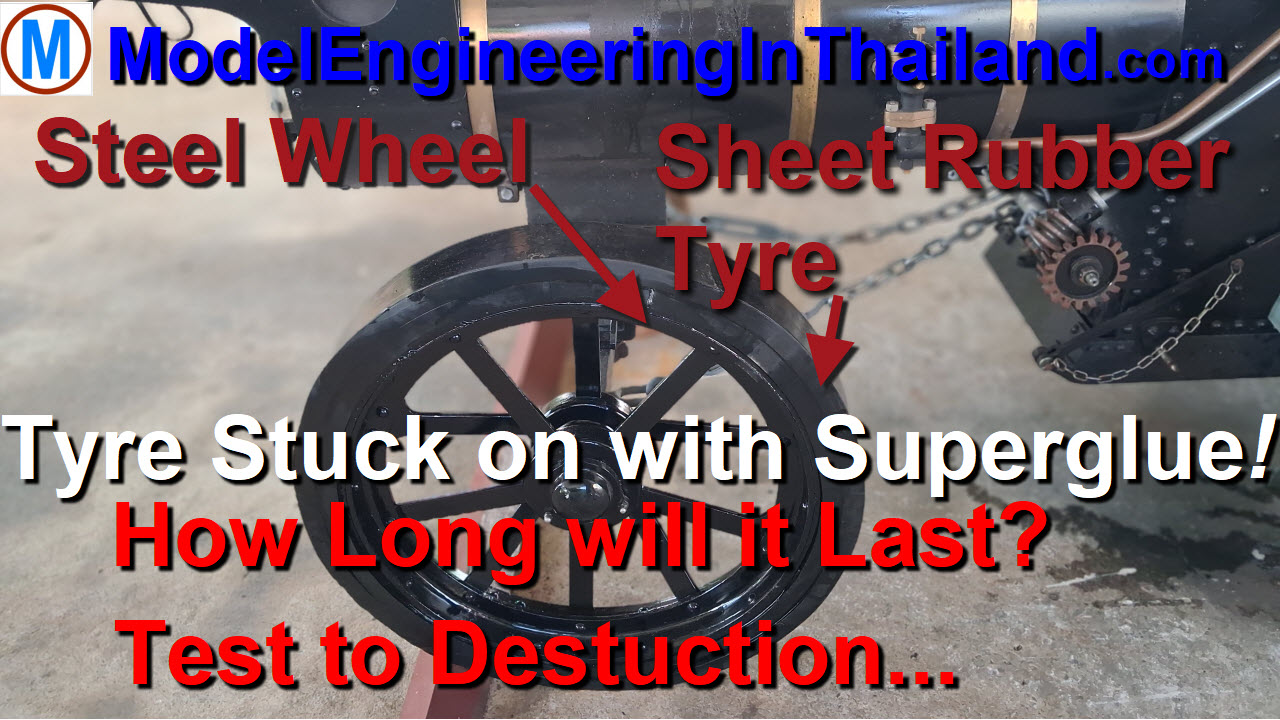
Rubber Sheet on Steel Wheel
How to Fit Rubber Sheet Tyres to your Miniature Traction Engine and Test the Durability with a Simulated Dynamic Road Test. (Video Below)
Many builders of miniature traction engines of a scale suitable for the driver to sit on when running (4″ + Scale) don’t fit rubber tyres at first, including myself when I built my 6″ (half full size) miniature Little Samson Traction Engine.
But they soon learn that running steel straked wheels on asphalt roads is a real boneshaker and they look for ways to retrofit rubber tyres. I was one of those people.
I did my research online at first to see what and how other people had done. Result: Zero.
I also asked fellow traction engine builders about the subject and did some trial tests myself.
Apart from how to cut rubber sheet 20mm thick (a subject in itself) the main challenge seemed to be how to ‘stick’ the rubber to the existing steel wheels.
Superglue Ideas, Challenges and Challengers – Video
As soon as I had put forward my intention to use superglue to fix the rubber I was met with a barrage of comments challenging my decision. Well, I had started already and what followed was very interesting and informative (to me anyway).
To explain all this in a ‘digestible’ format I made a YouTube video of the whole process and issue and you can see it on YouTube or in the same video below.
Yet More Unanswered Questions!
Has the Dynamic Road Run Simulation Test answered all the questions about how to fix sheet rubber to steel traction engine tyres to make rubber tyres?
It’s clear from the video that the superglue and cap screw fixing method was perfectly adequate for the test. But what about real life running on the road?
Let’s see:-
- Was the load on the tyre made by pushing the roller into it comparable to the load imposed when running on the engine on a real road?
- What is the significance of the 1mm infeed shown in the video?
- Is a run time of 1 hour 8 minutes corresponding to 2.2 miles of road run sufficient to really test the effectiveness of the superglue and cap screw fixing method?
- The sheet rubber fixing method and simulated road test was for the front wheel only. Would the back (hind) wheel fixing method be the same?
- Would I be using normal superglue for the back (hind) wheels too?
- How did I cut the rubber strips from as huge sheet of 20mm thick natural rubber? How easy/difficult was it and would I do it differently for the back (hind) wheels?
- How easy/difficult was it to butt-join the two ends of each strip of rubber and apply superglue to the joint?
- How easy/difficult was it to fill in gaps between the different strips of rubber?
Answers Forthcoming Soon
I’ll be answering all those questions soon and posting a ton of photos illustrating the points above and clarifying the sheet rubber cutting and fixing method.
I’ll also be answering the superglue question and you might be surprised what I have to say about that!
Comment And Join
To make sure you join in the discussion, please leave your comments below.
To make sure you don’t miss the next episode please:-
and
An addition to your #1 concern is how well your superglued rubber junctions will hold up to rolling over graveled roads where rocks will continually produce sharp pressure points and impacts; smooth roads are gentle on all tires, gravel surfaces are far more harsh.
Finding that answer will likely require real-world testing.
Good luck 🙂