
Adding Sheet Rubber Tyres to a Traction Engine – Part 1
Materials Procurement and Design
| To view images below, just click on the image. Then browse through the Gallery using the < and > arrows. Escape to exit. |
A Bit of History
In preceding pages I explained why rubber tyres were necessary on a Steam Traction Engine with steel strakes like my 6″ scale Little Samson Traction Engine and I described my attempts at fitting sheet rubber tyres and cast rubber block strakes.
Comments from other Little Samson Traction Engine builders/owners with a lot more driving experience than myself dissuaded me from pursuing the rubber block strakes route and my normal local engineering workshop Teera Borigaan who at first quoted me for supplying cast rubber blocks (I had even made a mould to cast them in and made a sample block) declined to source the castings.
Finally – Rubber Sheet Procured
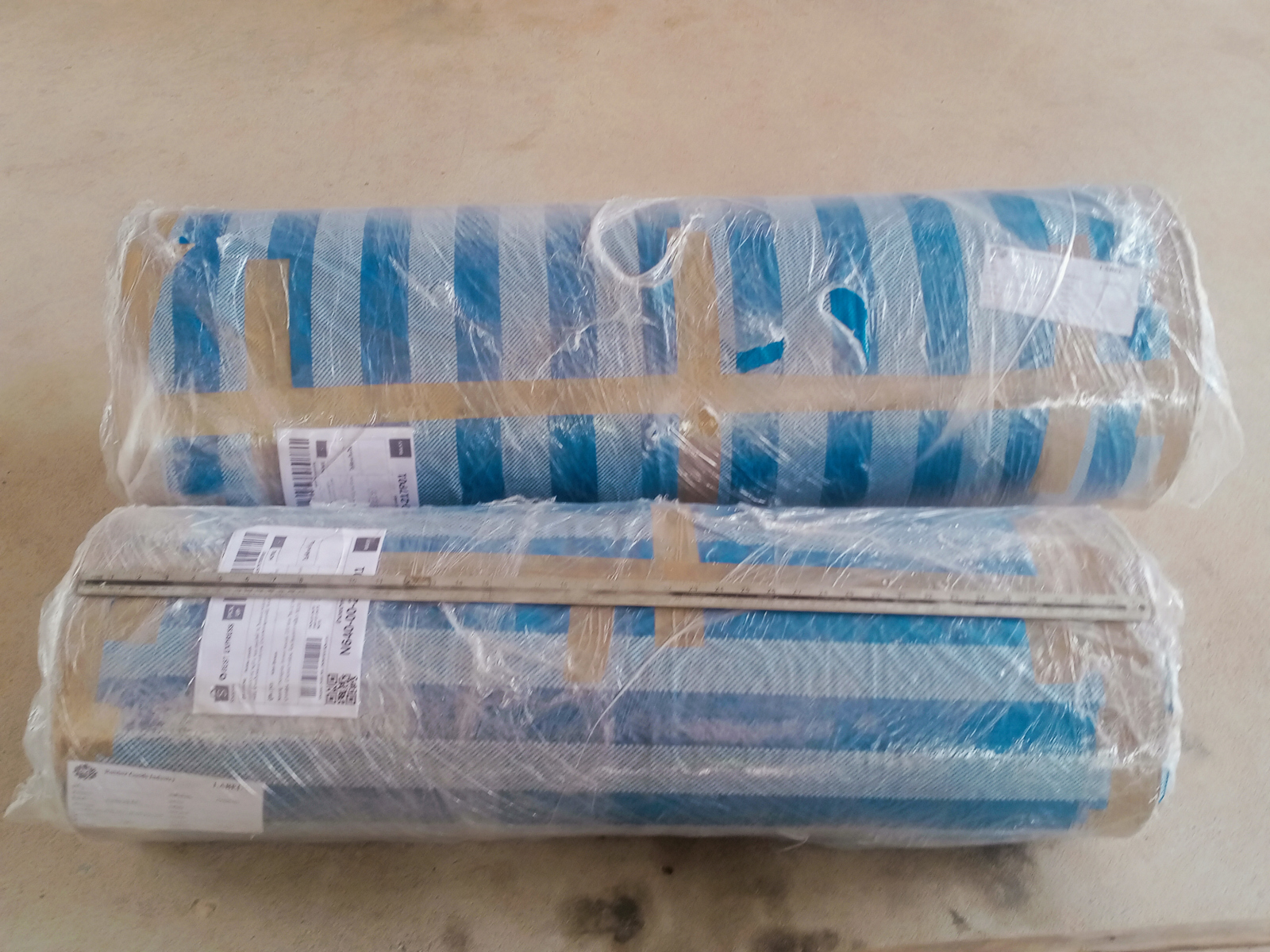
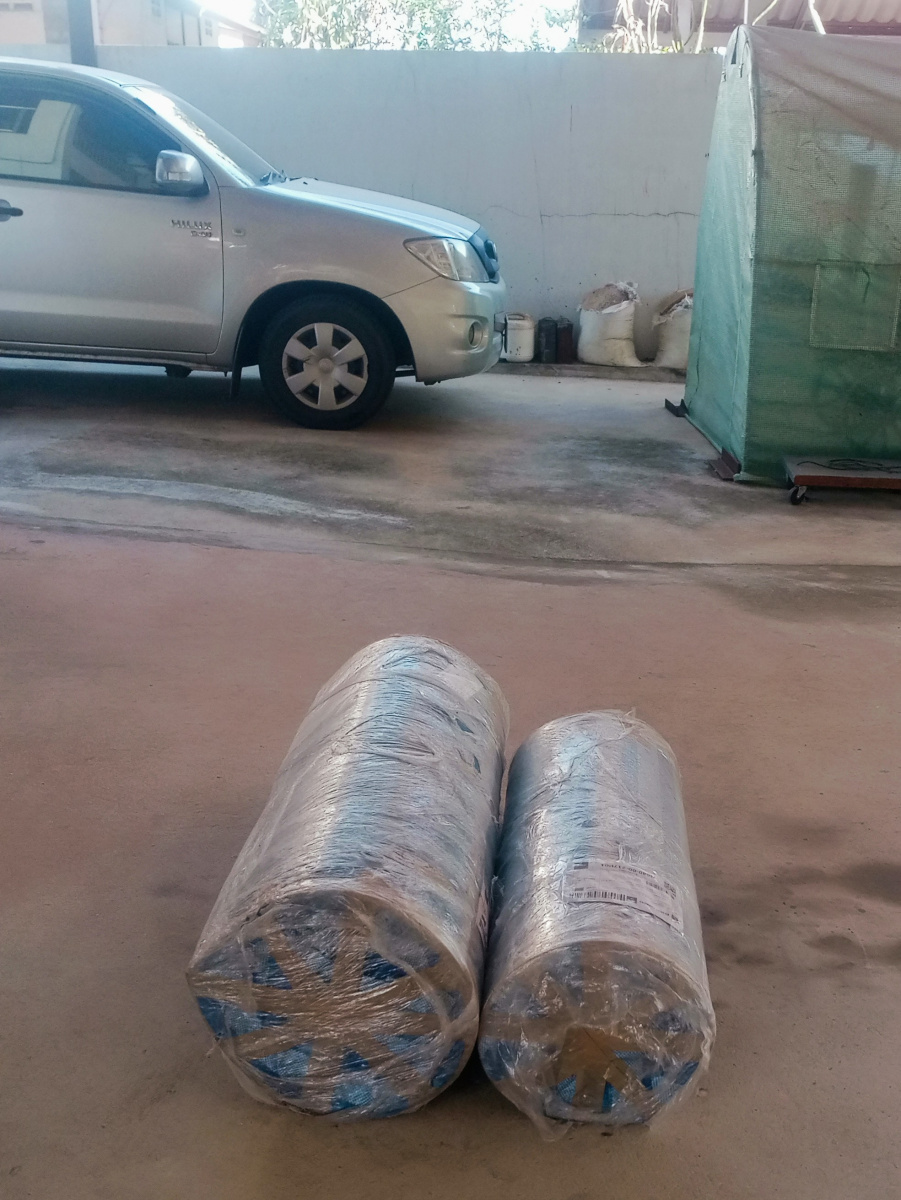
After many months of looking for a supplier of rubber sheet I eventually found one on the Shopee website in Thailand, placed my order and the rubber sheet was delivered to my workshop in two big and very heavy rolls, as you saw in the photos above.
Materials Specification and Quantity
All the rubber is 20mm thick and made from Natural Rubber. The rubber sheets are 1.2m wide, one sheet being 1m long, the second 2m long. Total Area 3.6m2.
For those who can read the Thai language, here is the label:-
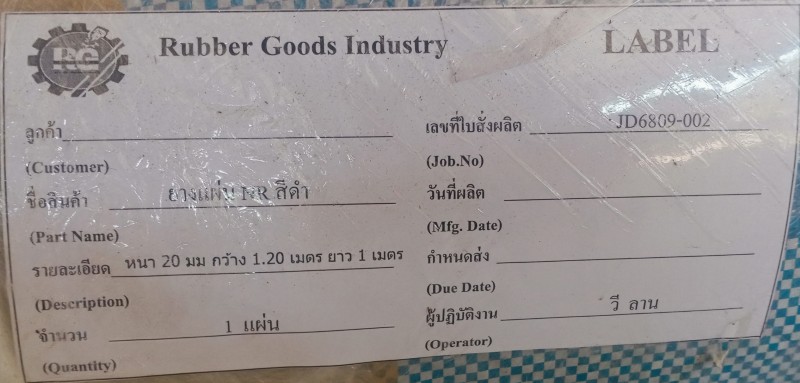
Photo of Label in Thai Script on Roll of Sheet Rubber
https://shopee.co.th/product/708273078/29715993678
|
Product Description Our rubber sheets are produced from factories in Thailand. The quality has received ISO 9001:2015 standards, with a complete production process starting from compounding. There is a tire testing room before and after production. And there is a production process that meets ISO quality standards, so customers can be confident that our products are definitely of high quality Usage: Rubber cushioning for machinery rubber mold rubber factory floor rubber sports field flooring Waterproof rubber sheets, etc Product Specs Operating temperature -50 To + 80 °C Hardness 70+/-5 Shore A Ordering Tire sizes are 2, 3, 8, 10, 12, 15, 20 mm thick and 1.20 meters wide. As for the length as desired, for example, if you press to select 1 meter, the customer will get 1 roll of 1 meter length or choose 2 meters. You will get 2 meters of length, 1 roll If the customer wants it to be cut into multiple sheets, the customer can inform us of the size via chat |
Next Step CAD Drawings
“What! CAD Drawings?” I hear you ask. “You just wrap it around the wheel and glue it on. No need for fancy CAD drawings!”
Well, let me tell you it’s not so simple as that. If fact there’s a lot more to it. And making CAD drawings forces the designer (me in this case) to consider all details and dimensions. Let me show you what I mean.
CAD Drawings of Rubber Sheet Tyres Applied to 6″ Little Samson Hind Wheels

CAD Drawing of Sheet Rubber Tyres On Hind Wheels

CAD Drawing of Sheet Rubber Tyres On Hind Wheels Details
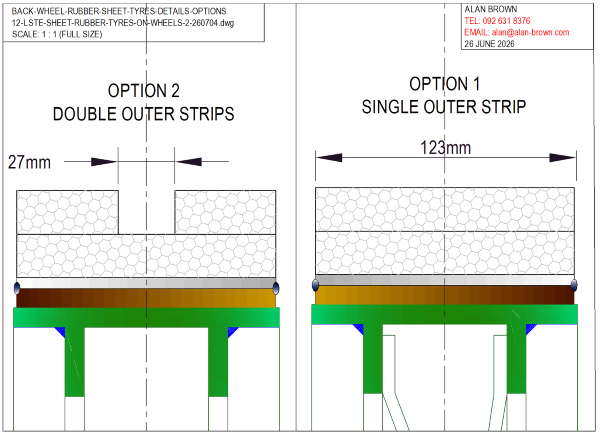
CAD Drawing of Sheet Rubber Tyres On Hind Wheels Options
Hind (Back) Straked Wheels
I did not want to glue the rubber strips directly to the strakes, because I was concerned that:-
- The ride would still be rough as there would be no support between the strakes
- The sharp edges of the strakes might cut into the rubber sheet at the edges of the strakes
- The area of contact between the rubber and the strakes would be 50% smaller than the potentially avalable perimeter of wheels without strakes
Final Hind Wheels Strakes And Rubber Sheet Configuration
The composition and method I am proposing the attach the rubber sheet to the steel-straked rear wheels is described below and seems to follow what is commonly adopted where rubber tyres are retro-fitted to traction engine wheels with steel strakes.
In essence the method of fixing the rubber-sheet to the straked wheels requires a steel band or hoop to be rolled up to fit tightly over the outer diameter of the strakes. The butt joint of the ends of the band will be welded and ground smooth and spot welded to the steel strakes at intervals around the wheel.
For corrosion protection all bare steel on the wheels and the steel band will be sprayed with zinc-rich paint – EXCEPT for the outer surface to which the rubber sheet will be glued.
Next the rubber sheet will be cut into strips and glued to the steel using cyanoacrylate adhesive (‘Super Glue’). Two layers of rubber strip will be applied.
Configuration and Dimensions Of The Components
At the moment my CAD drawings show:-
- Steel Band 5 mm thick. (Nominally 1/8″)
- Steel Band width = full width of the Strakes – 123 mm (4.8 inches)
- Rubber Sheet 20mm thick X two layers = 40mm
- Option 1. Rubber Sheet width = full width of the Strakes – 123mm (4.8 inches)
- Option 2. Outer Rubber Sheet in two separate bands with a gap of (say) 27mm between them
Option 2 of two bands of rubber seems to be what most engines have when the rubber tyres are applied professionally. I don’t know the pros and cons of this compared to a single band.
Unresolved Questions, Issues and Concerns
| Issue | Comments | |
|---|---|---|
| 1 | Thickness of Steel Band | Nominal 5mm shown. Is it adequate? Too thick? |
| 2 | Thickness of Rubber A) Ride Quality B) Gearing | A) Total thickness of rubber is 40mm. Will this give a good ride? Any other effects? B)Rubber adds 80mm to the diameter of the wheel thereby reducing the gearing of the engine (faster travel for same crank revs). The gearing is already a bit low i.e. a bigger gear ratio is referred not a lower one. |
| 2 | Width of Rubber (One or Two Strips) | What are the benefits (if any) of proving two outer rubber bands rather that a single bad the full width of the strakes? |
| 4 | Corrosion Protection | Nominal corrosion protection by means of zinc-rich spray paint is shown. In the long term is this adequate to protect the inaccessible gaps between the strakes? Not that the engine is never steamed in wet weather. |
| 5 | Choice of Adhesive | A strong case for Super Glue has been presented. Is there any experience in the field upon which to draw? |
| 6 | Cutting Rubber Sheet | Cutting Rubber Sheet is difficult without large and expensive equipment. Teera has said that they can't cut it even with their big 20T guillotine. I have had success with a simple hand held jigsaw. Does anyone have any experience I can learn from? |
Comments Welcome
Please feel free to add your comments below.
Alan,
I glued the tyres on the Ruston according to the rubber suppliers recommendations which was to join the ends of the rubber with industrial superglue to make a complete tyre about an inch smaller in circumference than the wheel rim, coat the contact surfaces liberally with isoflex (which is a rubber roofing compound containing fibres) and then stretch the tyre over with tyre levers. It lasted about 18 months before the first one fell off! Second time I was advised to use tiger seal but I couldn’t lay my hands on that easily so I used sikaflex as through work we used their products to glue windows on ships and for other sealing tasks. Sika products are also used to glue aircraft together. I was advised by others to use a flexible bonding compound as the rubber distorts as the wheel revolves so to avoid distorting and peeling the bond it needed to have some compliance. The Sika lasted about two years before one fell off!
If I remember my conversation with Izzy Nelson correctly I believe he had his tyres vulcanised and they fell off several times and in the end the only way he could keep them on was to through bolt to the rims. Chris B has that engine now and the bolts are still there and the tyres still on.
Tyres on my Samson are vulcanised and I left the wheels as cast rather than machine the OD so there was a really good ‘profile’ for the rubber to key into. So far they have done over 100 miles and fingers crossed still holding on!
What did I learn? The superglued end joints held fast on the Ruston but the bond to the wheel failed three times (I had a second go with Sika as well). I did rough the rubber up and the steel of the wheel but I suspect the roughness I achieved was not good enough. I also made sure everything was grease free with solvent cleaner. From that experience I don’t think I would personally try glued tyres again, especially on the rear wheels, certainly not above 4” scale without some mechanical fixings right through.
Be interested to see how you get on with superglue. You may well be successful, I don’t know, maybe the advice I was given re the flexure of the rubber was wrong and a rigid bond will work. I guess also you won’t be covering a lot of miles so that may help. I never ‘clocked’ the mileage on the Ruston, from experience of actually recording distance on the Savage I would guess I probably did 100 miles with it in 10 years, so maybe around 30 to the first failure, 50 to the second and 20 to the last, but that is purely guesswork. It ran on grass, concrete and ashphalt road and loose surfaces like stone so it had a fairly varied service life.
Good luck with it, hope you do better than I did.
Hi Paul and many thanks for your valuable comments which I will consider carefully before applying rubber to steel on my Little Samson Traction Engine.
I think the simplest and probably the strongest method to secure the rubber in addition to the adhesive is to add cap screws through the rubber and into the steel strakes. This was described in my Cast Rubber Block Strakes – Version 2 post.
I would probably put the cap screws in immediately after the first layer of rubber was glued in place and use pan-head cap screws so that there would be no need to form holes in the outer layer of rubber. The holes for the cap screws in the first layer of rubber would be formed using a Forstner type trepanning tool.
The issues you describe of the rubber tyres separating from the steel wheels is probably caused by what is called in engineering terms ‘Hysteresis’. It’s a well known phenomenon and accounts for 80 ~ 90 % of of a tyre’s rolling resistance.