
Watch: 3/4″ Scale Bassett Lowke Traction Engine First Run
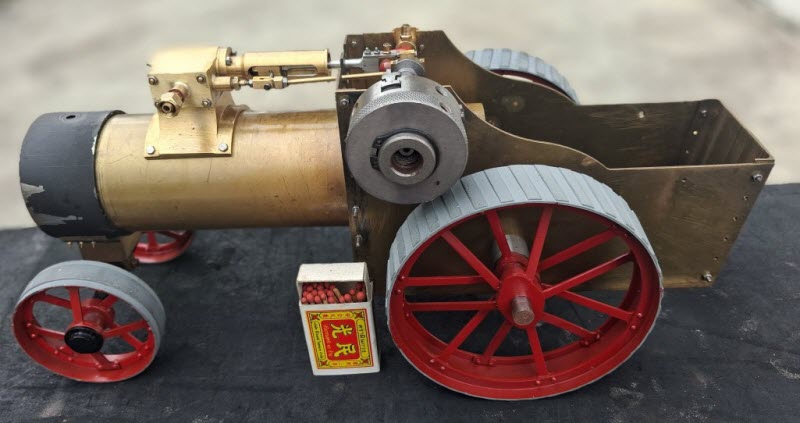
3/4″ Scale Bassett Lowke Traction Engine Running on Air
See the highly anticipated moment the 3/4″ scale Bassett Lowke Burrell traction engine model spins under power for the very first time.
Initial Testing Highlights
- Zero-Adjustment Start: The engine ran beautifully right away on workshop compressed air.
- Flawless Valve Timing: Experience gained from building the 6″ scale Little Samson paid off with perfect slide valve alignment.
- Temporary Flywheel: A small lathe chuck was temporarily pressed into service to help balance the motion.
- Single Eccentric Set up: Reversing valve gear is still to be built, so it is running with a single rod for now.
Deviating From the 1950s Blueprints
While this build uses the original 1950 Bassett Lowke drawings, it is far from a standard box-build. The original post-WWII design relied on 26 pre-made castings that are no longer available. Every single component is being mapped in CAD and precision-machined from solid stock.
To eliminate what I consider some “ugly” un-prototypical features of the original design, I am heavily detailing this engine with scale improvements. I am integrating finer mechanical details inspired by W.J. Hughes‘ legendary 1.5″ scale Allchin design. Modifications will include scale-accurate driving gears, neatened steam pipework, and a proper curved reversing link to replace the clumsy straight version.
Don’t let the compact 3/4″ scale fool you; this miniature project is a complex masterpiece with nearly as many parts as a half-sized engine.
Follow the Full Build Step-by-Step
- Check out the complete image history on the BLTE Build Progress Gallery Page.
- Compare this project to my previous heavy project on the Little Samson 6″ Scale Homepage.
Hello, Graham and thank you for your comments and nice words.
I do hope you are enjoying time with your daughter; with Australia so far away from England it must be a rare occasion. She probably didn’t fly over all the way from Australia to see you working in the workshop and looking at model engineering websites!
I must say,I, too am surprised at how fiddly these small models are to make. I am down to 12BA screws only 1.2mm in diameter. I have to make my own spanners for these tiny screws, with head sizes of 2.3mm (90- ‘thou’) across flats.
I’m now machining up the proper spoked flywheel from a solid lump of cast iron to replace the lathe chuck.
Your lock and key making activities sound interesting, in particular the nickel plating is something I’m sure our readers would be interested in learning more about.
I’ll keep you posted when the flywheel is fitted and I hope to get some sweet, low speed, running of the engine on air.
Again thank you for your comment – much appreciated.
Good evening Alan,
I must apologise for the delay in answering your email, life’s been a little hectic recently, my Daughter who emigrated to Australia is over for a holiday, I must congratulate you on your build of the Basset Lowke engine it really is a superb job [especially the temp 3 jaw flywheel] very thoughtfull, it looks & sounds fantastic,& as you say smaller engines are harder & fiddley to make than larger ones, I’ve not done much modelling in the workshop but I made a very large key for our local church door, which involved turning, milling silver soldering, forging & jewellers sawing & filing, then I nickel plated it, I’ve done a few castings for a local vintage bus group in alloy & some brass, I also machined some parts for a church bell in Commondale [near whitby] & repaired the bearings & we rehung it [there was scaffold up] & fitted a new bell rrope complete with the sally on the bottom, I’m now making parts for a vintage mortice lock as well as looking after our large veg garden we’ve not had much rain so watering the veg every day, we’re on a meter but have about 1000 gals of water storage from the house & our barn roofs but getting low!! I also play button accordion in a local folk group mostly Irish folk music, all for now Alan look forward to seeing your progress Kind Regards Graham.