
Applying Sheet Rubber Tyres to the 6″ Little Samson Traction Engine – Stage 2 Final Design
(08 August, 2026)
General Arrangement Drawing
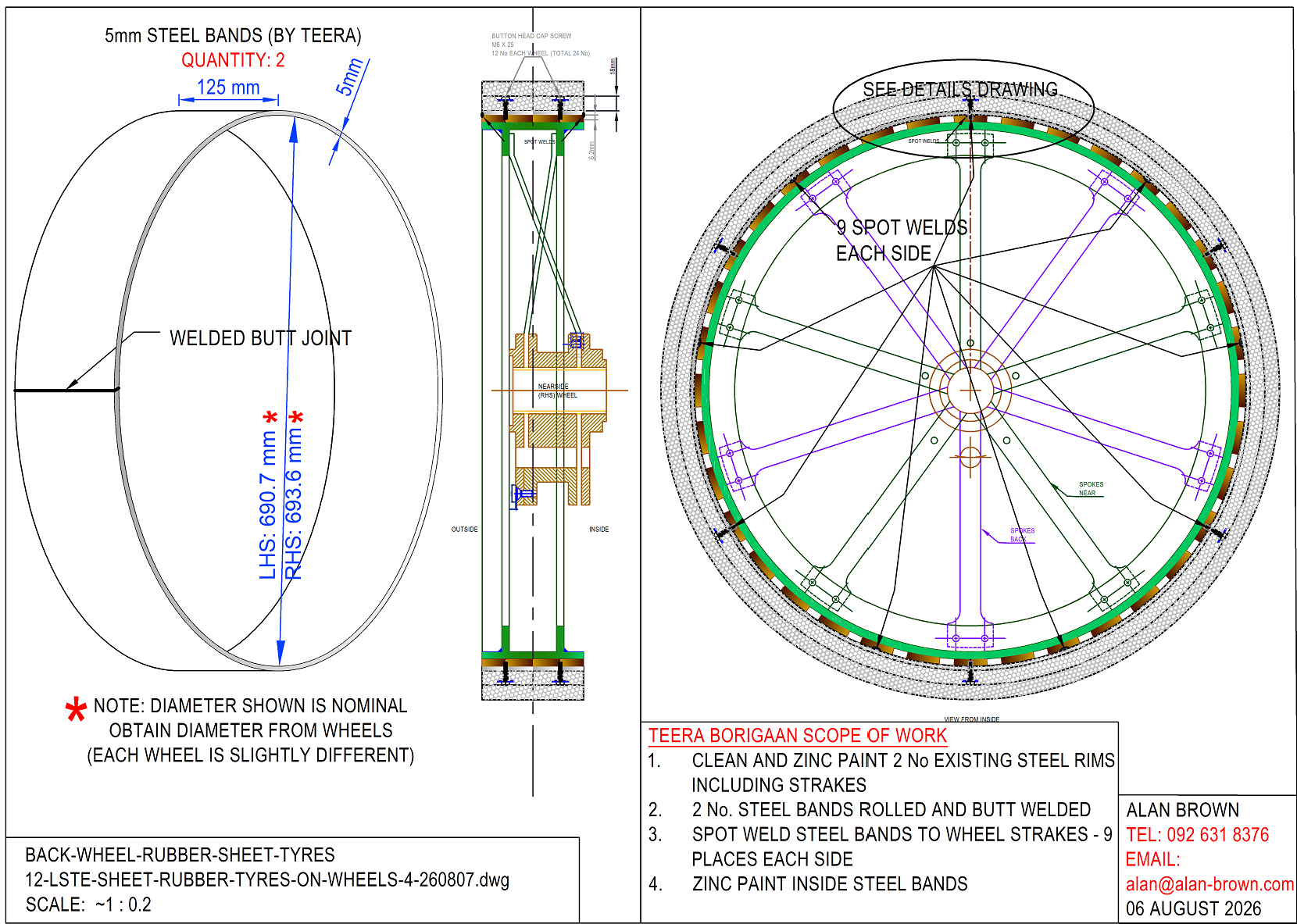
Back Wheel Rubber Sheet Tyres General Arrangement
Redesigned and Redrawn CAD Drawings
Taking on board further comments from our community members and applying a little careful thought myself plus, in particular, allowing for actual dimensions of materials and components and the results of the behaviour of the rubber sheet in workshop trials the design was finalised and the CAD redrawn.
The revised General Arrangement is show above, but the scale it is displayed at is too small to appreciate the subtle changes to the design from previously. So here are some detailed drawings.
Detailed Drawings – Section
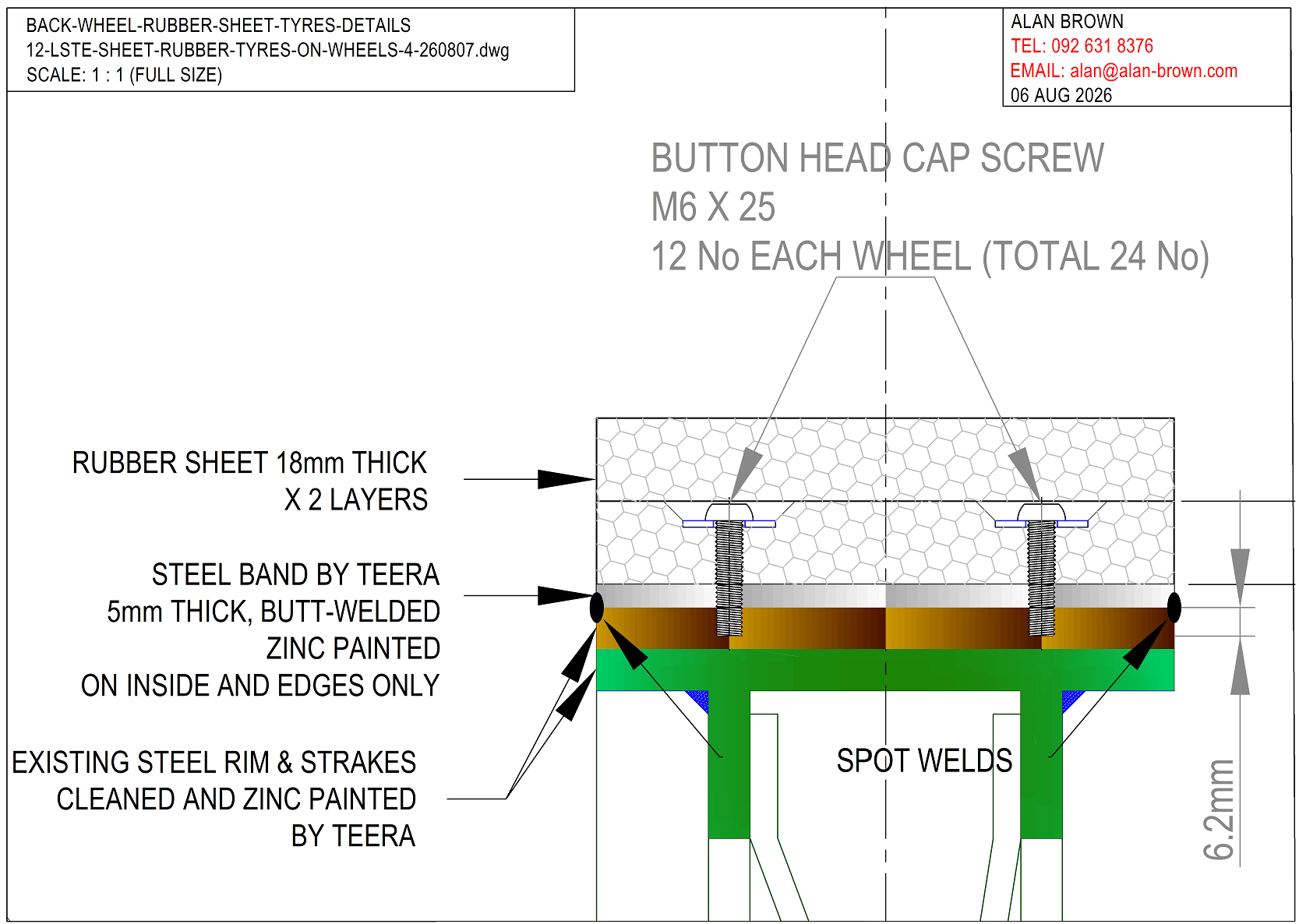
Back Wheel Rubber Sheet Tyres Details
So what has changed from the previous design?
- The sheet rubber thickness is taken from measurement of the actual sheet rubber delivered and is 18mm not 20mm.
- The The inner ring of rubber will be fixed with stainless steel dome-head cap screws in addition to the ‘super glue. The cap screws will be fitted with oversize washers.
- The drawing (above) shows the screws and washers pulling the first layer of rubber downwards. This is not a nominal ‘or guessed’ distance but was measured using an actual test setup as shown below.
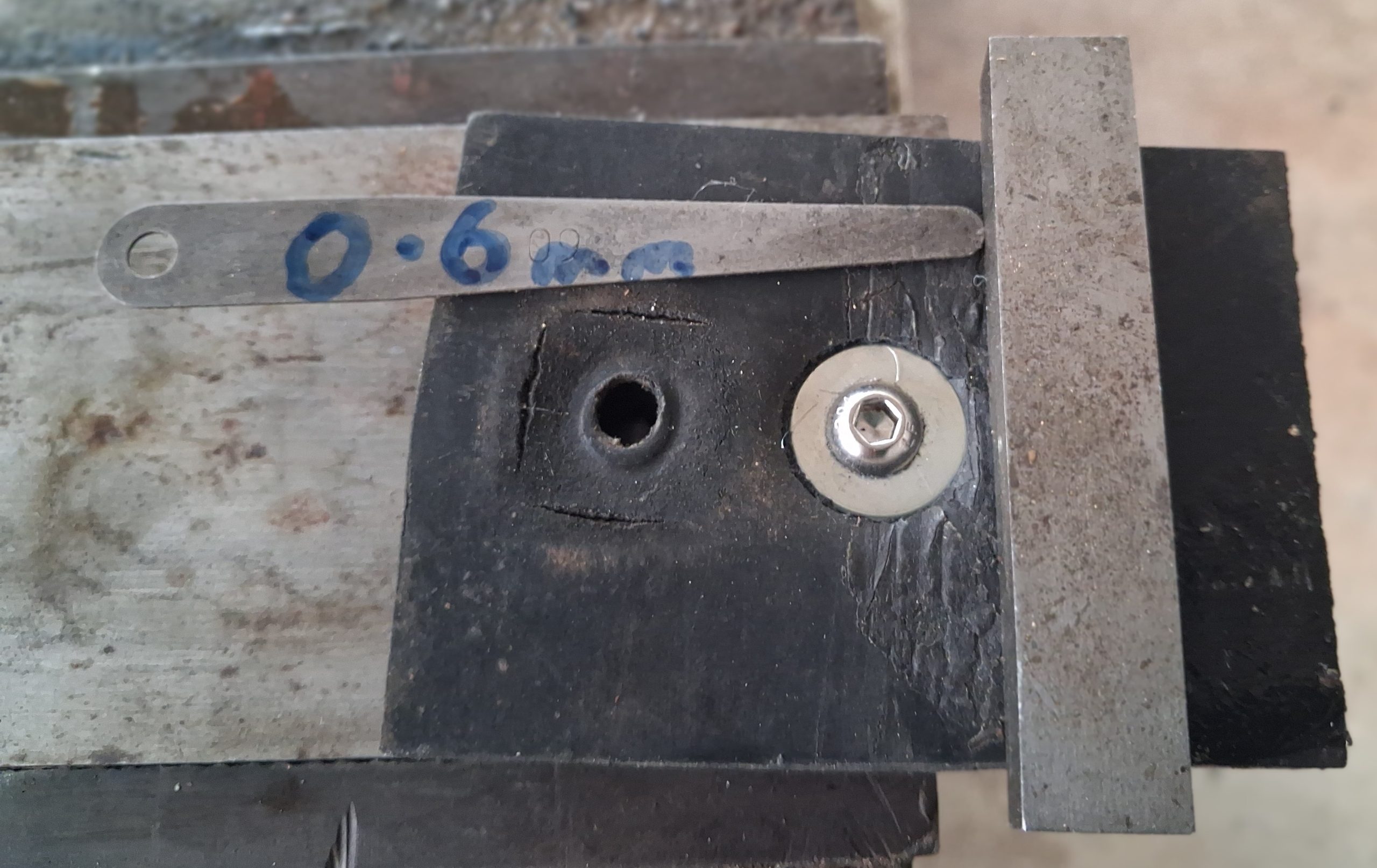
LSTE-Rubber-Sheet-Wheels-Workshop-Tests-260807-01
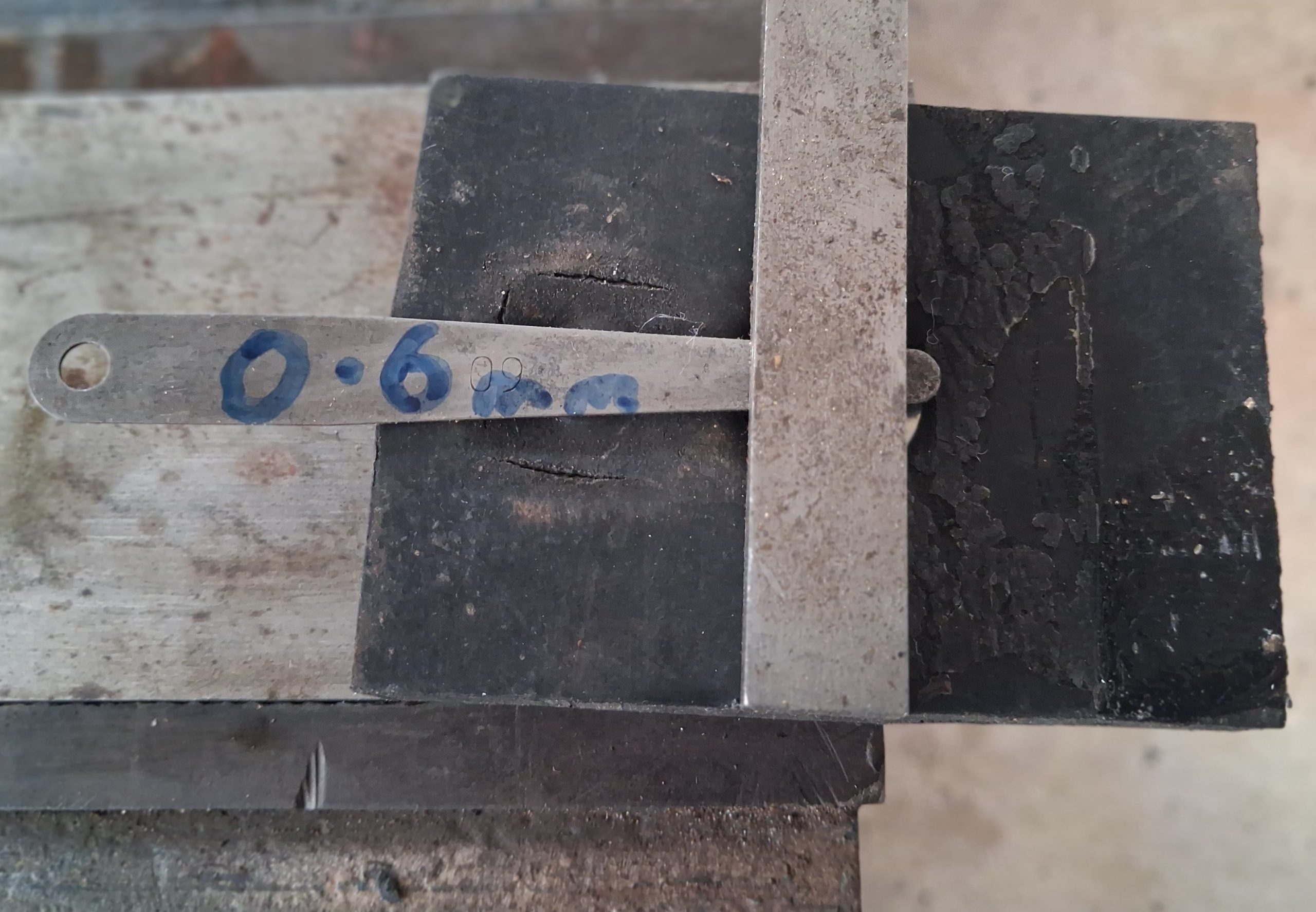
LSTE-Rubber-Sheet-Wheels-Workshop-Tests-260807-02
The above shows that the dome-headed cap screw has pulled the top line of rubber sheet down by the thickness of the washer (1.2mm) plus the dome head height (3.6mm) plus the air gap (0.6mm) total 5.4mm. This is with the screw being driven into an open-bottomed tapped hole just about as tight as can be done using an Allen key and tube lever.
Why this is Such an Important Dimension
A favourite adage of mine that I frequently quote regarding fasteners on my Little Samson Traction Engine is “If it isn’t Loctited, lock-nutted, wired or pined it will vibrate loose”.
So how to prevent the dome headed cap screws holding the sheet rubber (in addition to superglue) to the sheet steel wheel band? I don’t want to use any kind of adhesive because according to advice from my colleagues at some time I will have to replace them and the only way to release the adhesive in this case is using the blow torch which would damage the paint. So that is ruled out.
I figured that an effective ‘lock-nut’ effect could be obtained by driving the cap screw into a blind tapped hole. This needs precise dimensions for the length of the screw thread, depth of tapped hole, thickness of rubber and the amount as explained above by which the rubber is deformed by the cap screw.
Detailed Drawing Side View
This drawing explains the components of the proposed final redesign and also helps to explain the work I’m expecting Teera Borigaan (my local machine shop) to undertake.
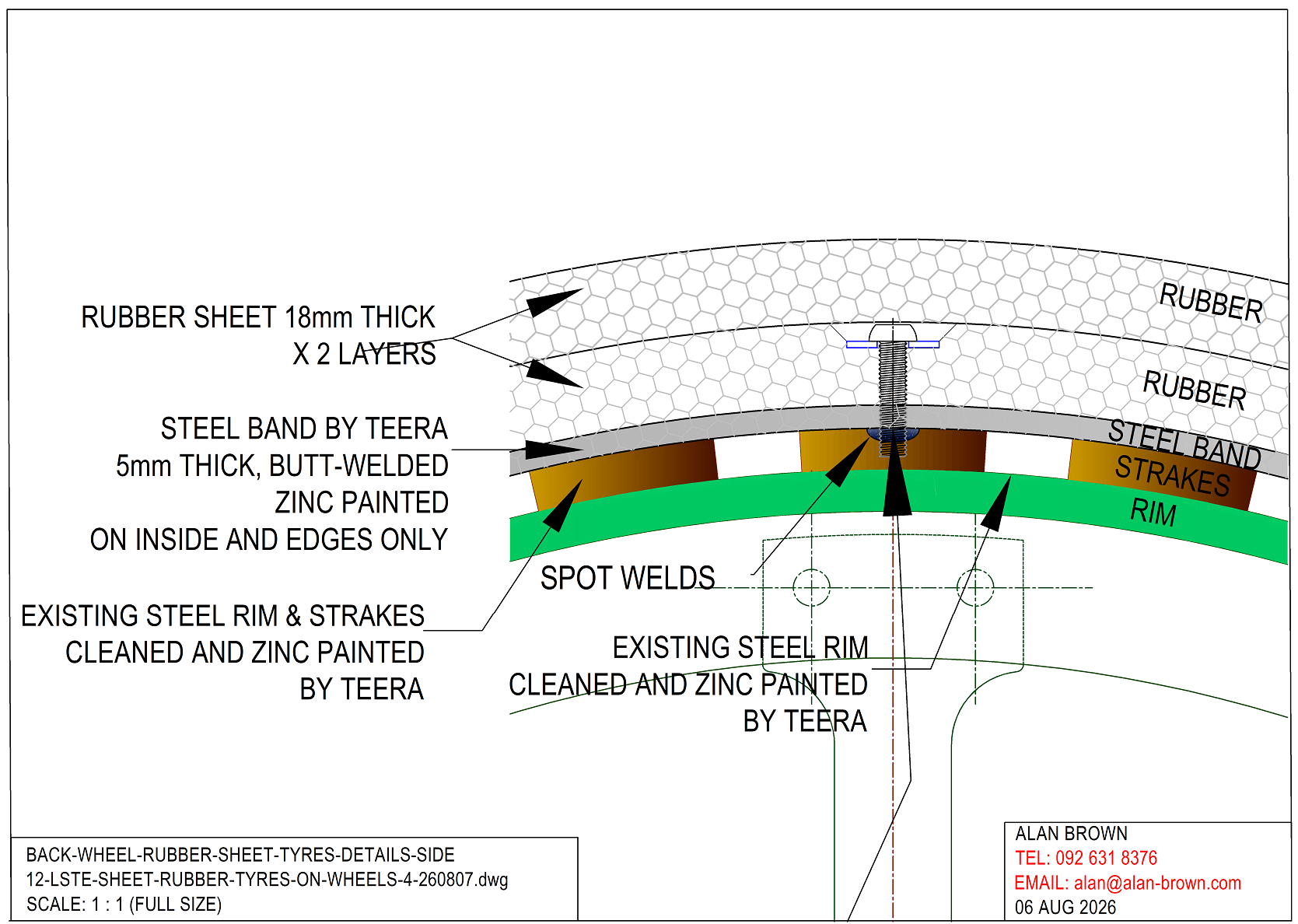
Back Wheel Rubber Sheet Tyres Details Side View
Anticipated Scope of Teera Borigaan Works
A short description of the works I would like Teera to undertake is shown in the very first drawing above. But, although the proprietor of Teera Borigaan can speak very good English his workshop and hence he himself are all very busy have a short attention span for non-engineering details like ‘scope of work’. Also his Thai workers have limited knowledge of English so I thought it would be a good idea to expand on the ‘Scope of Works’ and provide a Thai language version. That’s what the next drawing is for.
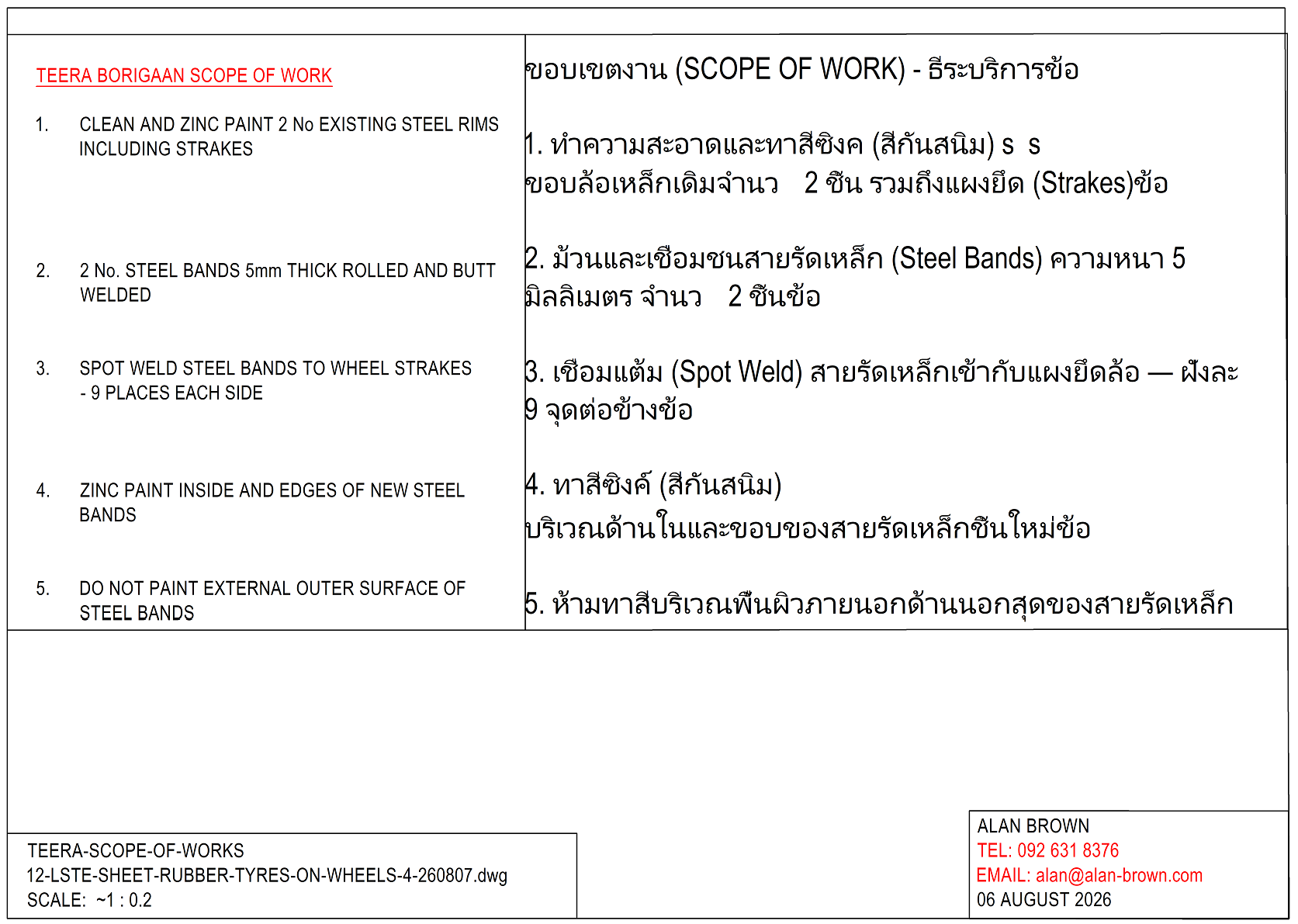
Teera Borigaan Scope of Works
Note that the main works required of Teera Borigaan is to roll the two steel bands. I don’t have a roller that big. Everything else I can do myself but I prefer to offload as much work to outside as possible. (Far to busy on other things such as building my Bassett Lowke Traction Engine Model.)
Meeting With Teera Borigaan
This is where the fun starts!
I had to drag the proprietor, Mr Boi, out from the depths of his machine shop, where no doubt he was dealing with other things far more important than my little steel bands.
He griped at the diameter dimensions for the 5mm steel bands I had indicated in the first drawing i.e. 690.7 and 693.6mm even though they were clearly marked as nominal and actual bands are to be rolled to fit the wheels which I would bring into his shop.
He thought I wanted to have the bands rolled to these stated dimensions and started to talk about machining oversized rings down to size in the lathe!
It took me a long tome to explain that I would bring the wheels into his shop next week and he could roll the bands to suit.
Eventually he understood and agreed to roll the bands for me.
But my time was up. He had made his offer, I had accepted and that was the end of the meeting.
No time to talk about cleaning the wheels, spot welding nor painting.
Guess I’ll have to do that.
Next Actions
Well, now it’s down to me to:-
- Take off the back wheels
- Clean the wheel rims and strake with the angle grinder and various rotary abrasive tools
- Spray paint the bare steel with zinc-rich spray
Until next time then, . . . please leave a comment below.
Hi Alan
Having seen the workshop I Have no doubt Teera can do the job with no problem. But sometimes as you say when discussing the fine points their minds do tend to wander away. At the same time saying “no problem I can do” Then doing something totally different.
The drawings look very professional. Wish I had learnt to use cad years ago.
I still use my fathers old tee square and a couple of plastic set squares.
I can remember the second time we took the engine out just how many bits vibrated loose.
good luck with the wheels George.
George, you’re spot on when referring to dealing with Thais and wanting to discuss the finer details, particularly, as you say, ” their minds do tend to wander away. At the same time saying “no problem I can do” Then doing something totally different.”
I took my Traction Engine wheels to Teera as agreed for them to fit the steel bands. At the same time I gave Mr Boi a ‘modified’ drawings. It was just the first half of the first drawing showing the steel bands. No other details. “Just make the bands I said”.
I’ve been using AUTOCAD professionally and non-professional for well over 36 years and I still learn new features and tricks every day! And I’m talking mainly about 2D CAD – I never had the time to master 3D. AUTOCAD is an awesome program.
Bits breaking loose – yes I remember it well. If it ain’t Loctited, locknutted, wired, riveted, or otherwise mechanically secured every fastener on a 6″ scale model traction engine like my Little Samson Traction Engine with steel-straked wheels will come loose when running on Metalled Roads.
Another reason why I’m rubberising my Traction Engine wheels.
By the way I had an email from Teera yesterday to say my bands were ready for collection so I’ll go and get them later today.
Very unusual (unique, actually) for Teera to let me know when my job is ready.