
I Have The Steel Bands for the Back Wheels and Here I’m Preparing Them to Accept the Sheet Rubber Tyres
(08 September, 2026)
CAD Drawings Showing The Intended Final Design
The intended design and fixing details of the steel bands and sheet rubber tyres for the back wheels has changed as the project developed. To start this article off let’s see some nice CAD drawings of the latest design.
1. CAD - Back Wheels Showing Fixings Of Steel Band & Sheet Rubber

CAD - Back Wheels Showing Fixings Of Steel Band & Sheet Rubber
Where We’re At Now
In the last post “Applying Sheet Rubber Tyres to the 6″ Little Samson Traction Engine – Stage 2 Final Design” I concluded with a summary of my next actions whch were:-
- Take the back wheels into Teera and Teera would roll the bands to suit.
- Upon receipt of the bands from Teera I would:-
- Clean the wheel rims and strake with the angle grinder and various rotary abrasive tools
- Spray paint the bare steel with zinc-rich spray ready to take the rolled steel bands.
Here Is The Progress I Have Made
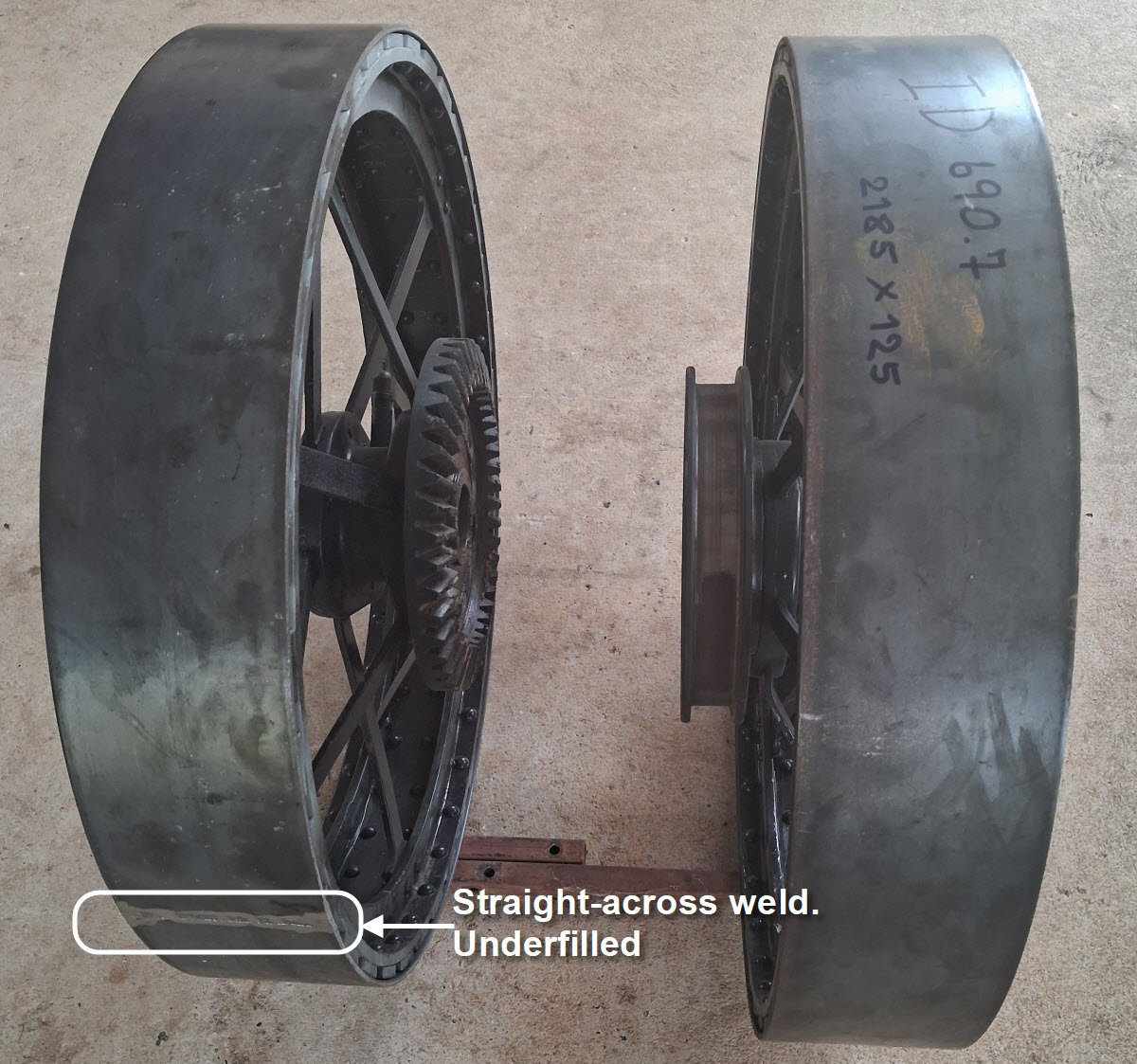
I have received the steel bands from Teera and inspected them. Referring to the photos these are the key points.
- The bands were very tight on the wheels and impossible to press off.
- The butt welds were at 90 deg straight across the bands. This is what I showed on my drawings but in retrospect the weld should be angled to suit the strakes.
- I took the angle grinder and slit the rims at an angle to match the strakes angle (is this why they’re called ‘angle’ grinders) so that when I remake the welded joint the thin (5mm) steel bands could be supported along the length of the new weld and
- a) prevent the welding from ‘burning through’ the steel bands
- b) allow full penetration welds to not only join the butt joint but also (maybe) penetrate into the strake
Having slit the bands and inspected them I noticed:-
- The butt weld by Teera was not a full-penetration weld – maybe 30 to 50% penetration only
- The insides of the bands were no corrosion protected in any way apart from the natural protection of the mill-scale
- The edges of the bands were very rough. They had been cut from steel sheet by a large guillotine with no subsequent dressing of the cut.
Steel Bands As Received From Teera, Cutting Them Off The Wheels, Applying Zinc Primer
All these items are shown in the Gallery below:
LSTE Back Wheels With Steel Bands from Teera
LSTE Back Wheels With Steel Bands from Teera
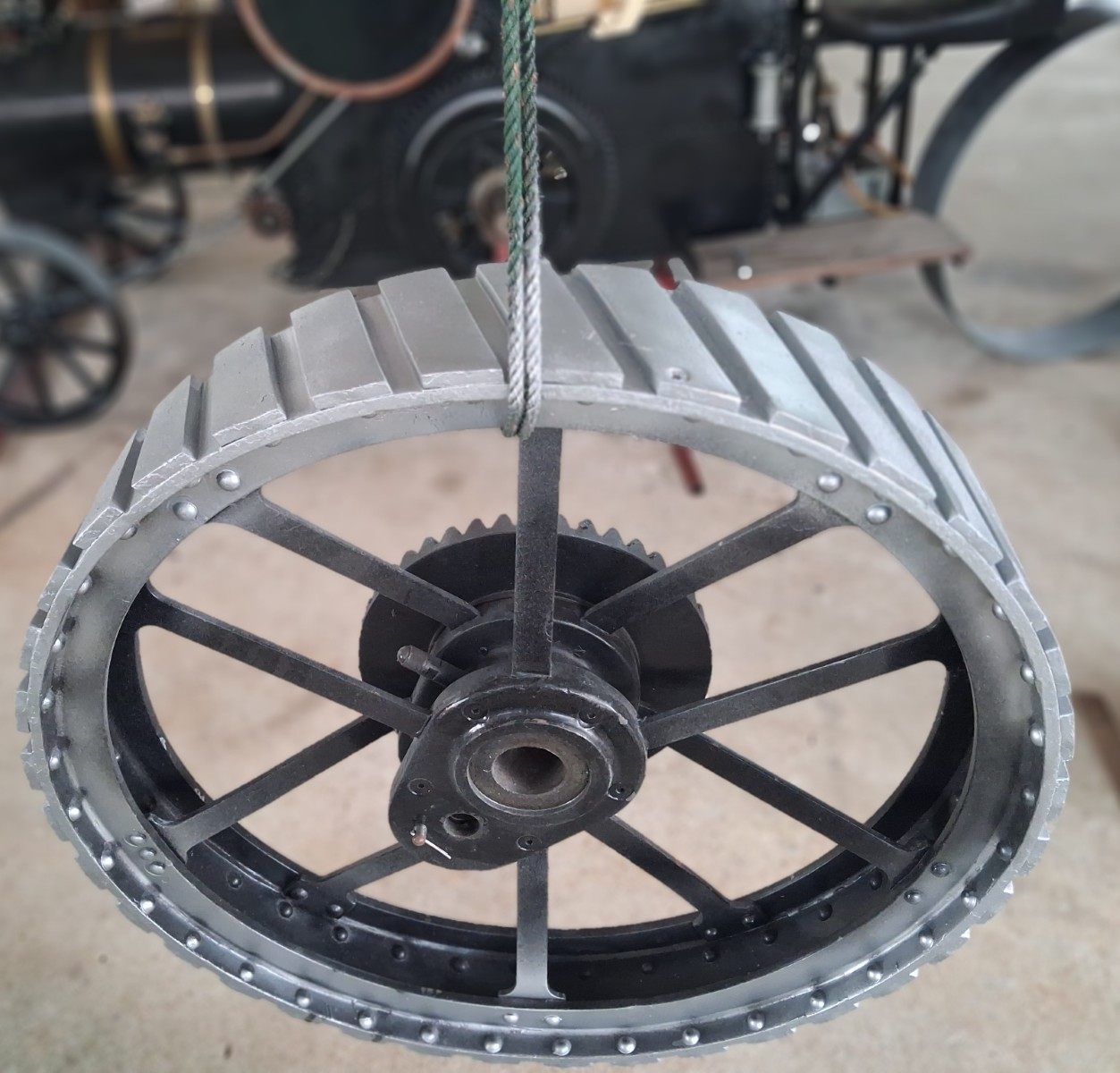
Painting The Steel Wheels And Strakes
I corrected all these items before putting the bands back on the wheels as shown in the following Gallery:
LHS Back Wheel Strakes Painted With Zinc-Rich Paint
LHS Back Wheel Strakes Painted With Zinc-Rich Paint
Fixing The Steel Bands To The Back Wheels
Method 1 Using 6mm C/SNK CAP Screws & Spot Welding
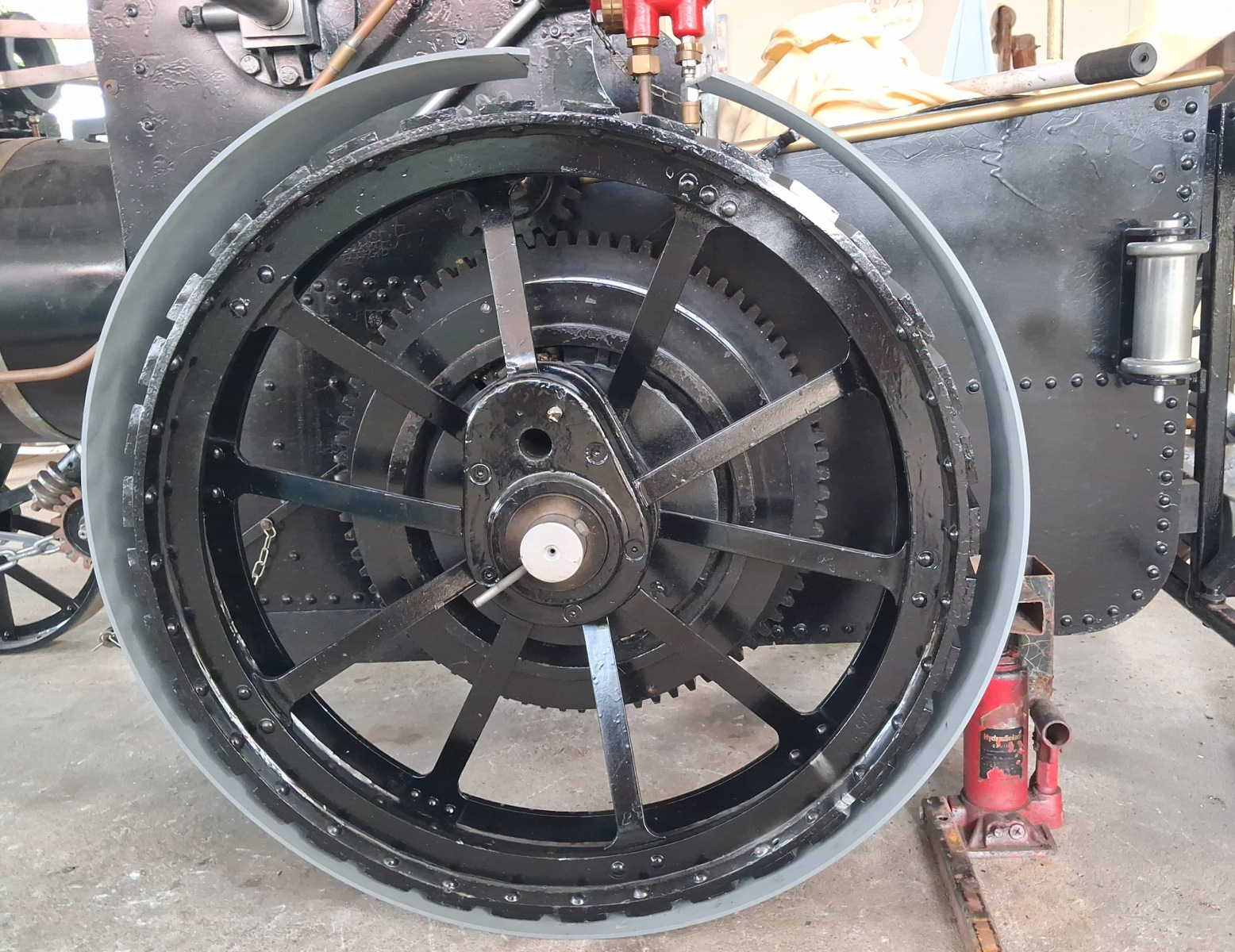
With this method I first tightly clamped the the steel band to the back wheel and fixed it with a single M6 Countersunk Head Cap Screw going through the band and into the strake, and secured it with Loctite 424 threadlocker.
Then the wheel and band was rotated 45 degrees making sure to pull the band close to the strakes and then clamp it tightly before using a second M6 screw to fix it as before.
I repeated this until I was back at the starting point and was pleased to see that the gap between the two ends of the steel band was comparable to that produced by the angle grinder when taking the band off the wheels originally. A final screw was used to fix the band.
The diagonal split in the steel band was then welded with plenty of amps to get good penetration and maybe some penetration also into the strake beneath the welded butt joint.
I then took the wheel off the engine and spot welded the steel band to the strakes at intervals on the engine side of the wheel, to hide them from view.
Finally the welds were all dressed down and made good with zinc-rich and then gloss black paint. With the wheel placed back on the engine the locations of the M6 screws were marked with aluminium tape ready for attaching the sheet rubber bands.
Note that the outside of the steel bands was not painted, but left in the original mill-finish to ensure the best possible adhesive of the sheet rubber by Superglue. (To be supplemented by stainless steel M6 Button-Head screws)
All this is shown in the Gallery below.
Loosely Fitting Steel Band Over LHS Back Wheel
Loosely Fitting Steel Band Over LHS Back Wheel
Next Episodes
Coming up in the next few articles:-
Jacking Frame Or Jacking Beam
Are you undergoing maintenance or any work that requires your 6″ Scale Little Samson Traction Engine to be lifted off the ground?
Removing a back wheel requires this and to remove the flywheel you have to first remove the Left Hand Side back wheel.
I always found that the hydraulic car jacks I was using were too tall to go under the back tank and resorted to reversing the engine onto wooden ramps to make room for the jacks. Then comes the issue of how do you remove the ramps and lower the engine to the ground again if you don’t want to drive the engine off?
The answer is – you can’t – unless you make a Jacking Frame.
In this article I’ll explain all about my Jacking Frame including dimensioned CAD drawings in case you want to make one.
Cutting The Sheet Rubber For Tyres
This is a topic for serious consideration. I have always assumed that I would be able to cut the sheet rubber which is nominally 20mm thick into the strips I need to make the sheet rubber tyres for my engine.
How would this be done? Teera said the despite having a massive machine shop and several multi-ton gilloutines that he couldn’t do it.
Find out how I did it in this episode.
Fixing The Sheet Rubber Tyres To The Wheels
And finally, how will the fixing of the sheet rubber to the steel bands go? I have shown the intent in my design drawings but how well will it work out in practive?
How good will the Superglue cyanoacrylate adhesive (CA) be?
I don’t know because I haven’t done it yet!
All will be reported in my usual detail in this sect
Please Comment Below
Adding a comment helps the search engines to find and promote this website. This is beneficial to all of us because the more ‘members’ there are the more interested and interesting like-minded people there will be for all to interact with.
On this subject…
Please Join The Little Samson Traction Engine Forum
Join the Little Samson Traction Engine Forum here. Have fun, meet other Little Samson owners/builders, have your say.